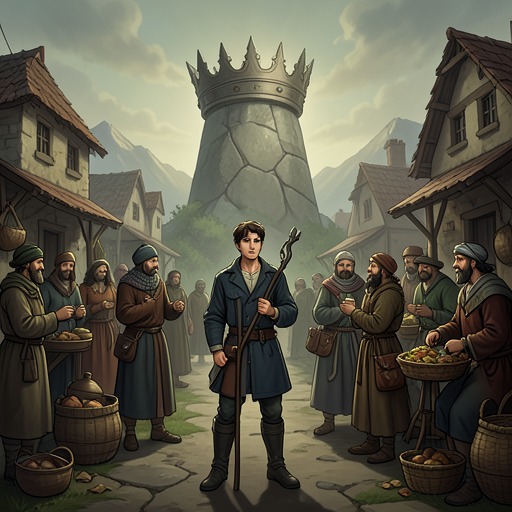
Rego Draz
Fire & BloodRego Draz was a merchant, trader, and money-changer from Pentos who rose from low birth to become the city’s richest man, only to be denied a seat among its magisters. Jaehaerys I Targaryen brought him to Westeros as master of coin, raised him to lordly rank, and relied on his ability to manage the Crown’s finances. Known at court as the Lord of Air because he held no lands, castle, or sworn men, Draz turned that joke into a measure of his practical power: he arranged loans, designed taxes, and found money for projects that reshaped King’s Landing. Yet the wealth and policies that made him useful also made him hated, and he died in a popular assault during the Shivers.
From Pentos to the King’s Council
Draz’s rise in Pentos brought him fortune but not acceptance. Though he had become the city’s richest man, his fellow Pentoshi scorned his low birth and refused him a place in the council of magisters. He therefore answered Jaehaerys’s summons willingly, bringing his family, friends, and immense fortune across the narrow sea to Westeros. The king granted him the title of lord so that he could stand with the other members of the royal council. Since he had no estate or household of sworn followers to accompany that dignity, courtiers dubbed him the Lord of Air. Draz met the mockery with amusement, turning the absence of land into a joke about the taxes he might collect if only the air belonged to him.
His appointment represented a striking choice. Advisors urged Jaehaerys to consider wealthy lords within the realm, but the king looked beyond the established nobility and chose a foreign-born financier whose riches came from trade. Draz’s exclusion in Pentos and elevation in Westeros form the defining reversal of his public life: the status denied him at home was bestowed by a young king who valued the skills behind his fortune. His position, however, remained exposed. He was a lord by royal grant rather than by inherited lands, and his authority depended on the Crown’s confidence and on results that would be visible to the realm.
Financing the Crown and the City
When Jaehaerys began to rule in his own right, the treasury was empty and the Crown’s debts were mounting. Draz addressed the immediate crisis by negotiating three substantial loans, approaching the Iron Bank of Braavos and its rivals in Tyrosh and Myr. By setting the lenders against one another, he secured terms as favorable as the Crown could reasonably expect. The loans allowed work on the Dragonpit on Rhaenys’s Hill to resume, bringing builders and stonemasons back to the site. Draz and the king both understood that borrowing bought time, not a lasting solution.
Their longer-term answer was to raise revenue without simply demanding gold from the lords or burdening ordinary trade at the ports and inns. Jaehaerys taxed costly goods that wealthy buyers wanted to display or consume: silk and samite, cloth-of-gold and cloth-of-silver, gemstones, Myrish lace and tapestries, Dornish wine but not wine from the Arbor, Dornish sand steeds, and ornate armor and helms made in the Free Cities. Spices faced the heaviest duties. Pepper, cloves, saffron, nutmeg, and cinnamon, already more costly than gold, became more expensive still. Draz joked that the Crown was taxing the very goods that had made him rich, an acknowledgment that his expertise and the king’s policy drew on the same world of luxury commerce.
The expenses of public works soon demanded more. In 52 AC, Jaehaerys ordered streets in King’s Landing widened, straightened, and cobbled where possible; the worst hovels were cleared, and a central square with trees, markets, and arcades became the hub of broad new streets. Later, after the Iron Bank forgave the remaining principal on its loan following Septon Barth’s return from Braavos, Draz examined the Crown’s debts and income and identified funds that could be redirected to further urban improvements. The king planned drains and sewers to carry waste beneath the streets and away to the river. To address the city’s poor drinking water, Septon Barth proposed wells, glazed-clay pipes and tunnels, four large cisterns, and public fountains. Draz’s financial work helped make those plans possible, linking the management of royal debt to the daily conditions of the capital’s inhabitants.
The Costs of Revenue and Reputation
The duties on imported luxuries and castle crenellations did not suffice to meet the combined cost of the Dragonpit and the city’s reconstruction. Draz therefore imposed a gate fee on people entering or leaving King’s Landing. The levy also charged for horses, mules, donkeys, and oxen, with wagons and carts taxed most heavily. Because traffic through the city was constant, the gate tax brought in more than enough to meet the Crown’s need. Its success in the treasury was a political failure for its author: opposition to Draz increased tenfold as the fee took effect.
His unpopularity had other sources. He was accused of stealing from the Crown, a charge he derided by pointing to his own great wealth. He was also criticized for not worshipping the Seven; he kept a small household idol, and gave little explanation of his faith. His mixed Pentoshi ancestry was another object of prejudice, but his wealth attracted the greatest resentment. He made no effort to hide it: silken robes, ruby rings, and a gilded palanquin displayed the fortune that had first secured him a place at court and then made him a conspicuous figure in the streets. A long summer, abundant harvests, and peace helped quiet public discontent for a time, but they did not erase the hostility attached to his taxes and status.
Draz’s work also extended beyond finance. When deaths on Dragonstone were discussed by the small council, he examined the maester’s accounts and rejected sickness as the explanation. Drawing on knowledge of the Free Cities, he suspected that the victims had been poisoned with Tears of Lys and reasoned that the maester had been killed first because he might have recognized the poison. His diagnosis introduced a possibility that had not occurred to the grieving queen and shocked Jaehaerys. The account presents this as Draz’s suspicion and inference, not as a verdict he himself could prove; it nevertheless shows him applying the practical knowledge of his foreign background to a matter of royal security.
Death and Legacy
During the Shivers, Draz continued to live in his own manse on the Street of Silk rather than take up residence in the Red Keep. The Dragonpit rose above the neighborhood on Rhaenys’s Hill, while Draz travelled between his manse and the castle in an ornate palanquin. One day his route passed through Flea Bottom. A group of hungry residents, already angry over the price of bread, blamed the master of coin for the cost of living; one also accused the Pentoshi of bringing the Shivers to the city. The crowd attacked, and the attackers took Draz’s clothing and rings before fleeing. His death was both the culmination of the resentment surrounding him and a reversal of the city’s own visible transformation: the mob used a cobblestone laid as part of the king’s improvements to kill the man whose financial administration had helped pay for them.
Jaehaerys rode out with the Kingsguard to claim Draz’s body and demanded that witnesses identify the attackers. A barefoot girl came forward with a name and led the king’s men to the first suspect, who was found with three of Draz’s rings. The suspect disclosed the other attackers, and the king ordered their capture and severe punishment. Draz’s death thus prompted a direct royal response, but it could not undo the public hostility that had made him vulnerable. His career leaves a distinctly double legacy: the Crown gained a capable financier who converted loans, trade, and taxation into royal resources and urban works, while the man who made those resources available became a symbol onto whom the city projected its economic hardship and fear of the foreign-born.